Your clients pay you to read their load curves, track down standby consumption and put a savings figure on it that holds up. Before you can start, you need the client's consumption data, and on many engagements getting it takes longer than the analysis itself.
The bottleneck is getting the data
An engagement runs in stages: a first meeting, scoping, analysis, the report. Between scoping and analysis, the client is supposed to send the data. In practice you get an Excel file with gaps, so you ask again, and by the time the values are complete a week has gone by.
With ten engagements, this loop repeats for every new client before the consulting work even starts.
Access runs through your client
The data belongs to your client, and you cannot pull the consumption figures yourself. You rely on the client sending them, and the client has other priorities. The export comes back incomplete, and the format changes from one client to the next. The usual ways to read out smart-meter data also go through your client, since the grid operator's portal needs their personal login and the interface on the meter needs someone on site.
Smart meters have not changed this on their own, even though they are already in place: around 97 percent of Austrian electricity connections have a smart meter that measures in 15-minute intervals.[1] You can get those values as soon as your client consents to sharing them. Since the ElWG, you then receive them at full resolution: the finest granularity is now the standard for authorised third parties, and the separate opt-in step has gone.[2] You still need a way to that data that does not go through your client's inbox.
Consent once, then the data arrives
Your client consents to sharing the data once, in their grid operator's portal, for their metering point. From then on, the 15-minute values arrive every day. Each new client gives their own consent, but only once, and you no longer have to chase anyone for spreadsheets.
They give it themselves, which is the route the law sets out, with the same company that operates their meter. For the client it takes a few clicks; after that their part is done, and you do not need to ask again.
How the consent step works
- You enter the client's metering point number, the 33-character number on their electricity bill.
- energiedaten.at sends the data request to the grid operator.
- Your client gives consent in their grid operator's portal.
- The data arrives every day. A separate post describes the route it takes from the meter to you.
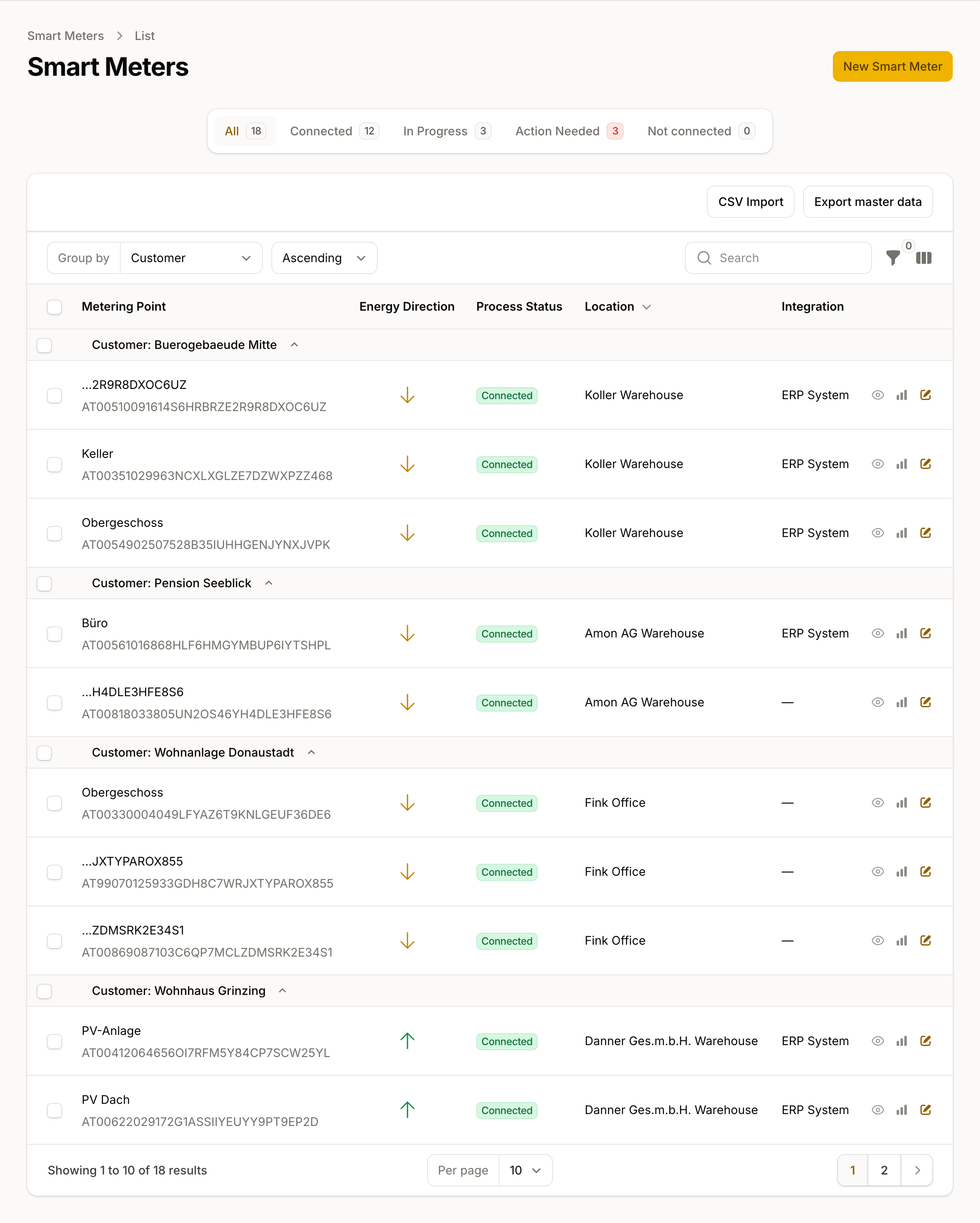
Consent applies per metering point, so a client with several sites gives consent once for each of their metering points. One overview shows, for every client, whether a request is pending, active or expired.
What you receive
For the analysis, you need the values in your own analysis tool. energiedaten.at therefore delivers the 15-minute values as CSV by email: daily or, depending on the engagement, as a scheduled export for the past week, month or quarter.
The values come straight from the grid operator, with quality flags and at the same interval that billing is based on. If a grid operator corrects a value later, the correction carries through to your data. A load-curve analysis needs history: on the Light plan you can request up to twelve months back, on the Plus plan up to 24.
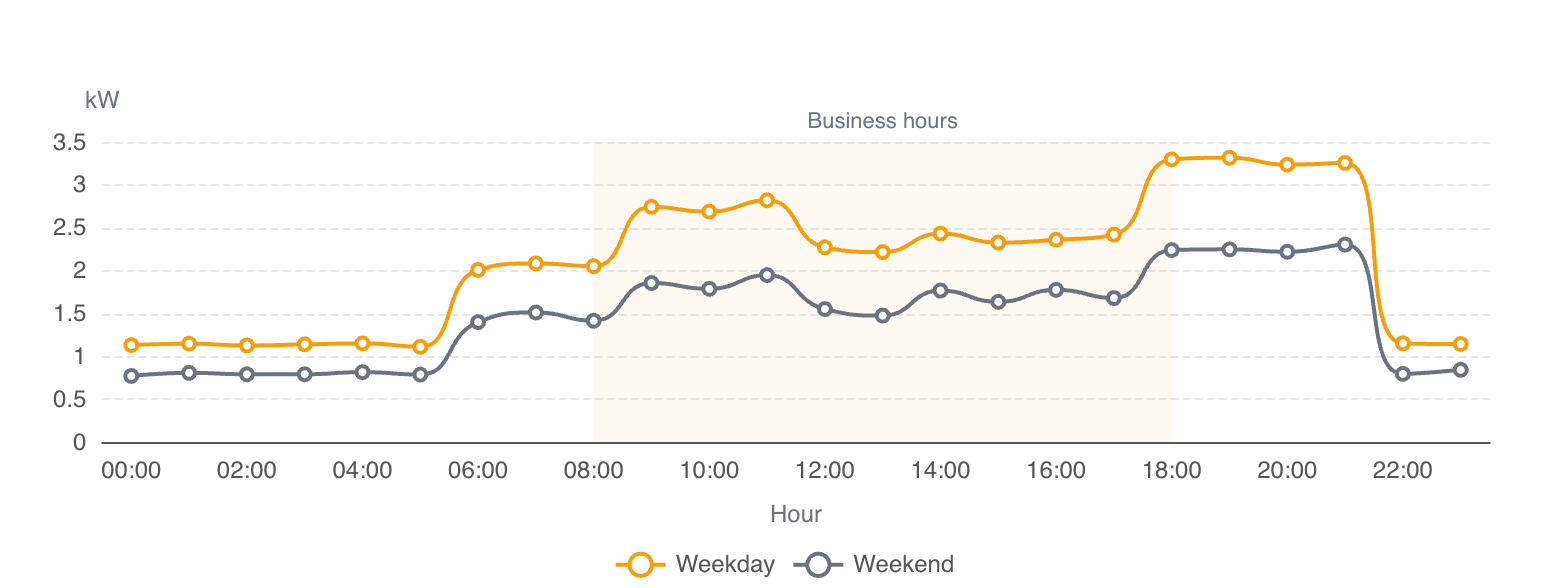
You decide what to do with the data: load-curve and standby analysis, preparing the EEffG short report, or a data basis for ESG reporting. The page for energy consulting gives an overview. If you would rather do the analysis in the platform, the load curve is there on every plan; the load duration curve, peak, heatmap and benchmark analyses are available from the Plus plan upwards.
What this means for a growing consultancy
You can start small: with the Light plan you bring in the data for your first client meters. As more engagements come in, the plan grows with you. The Plus plan is built for a larger client base.
And when an engagement ends? The consent belongs to your client, who can withdraw it at any time. When an engagement finishes, you end the data request for their metering point and export the values collected so far for your records.
Frequently asked questions
How do I request my client's load curve?
Your client gives consent once. You enter the metering point number, energiedaten.at requests the data from the grid operator, and your client consents in their grid operator's portal. From then on the load curve arrives every day as 15-minute values.
Do I need the client's consent?
Yes. The consumption data belongs to the client, and they give consent themselves in their grid operator's portal. The data only flows once they have, and they can withdraw consent at any time.
Do I receive the quarter-hourly values?
Yes. Since the ElWG, quarter-hourly values are the standard resolution; an authorised third party receives them as soon as the client consents.
What tool do I need for the load-curve analysis?
The one you already use. energiedaten.at delivers the values as CSV, which you open in Excel, your BI tool or your analysis software. Inside the platform you see the load curve on every plan, and the load duration curve, peak, heatmap and benchmark analyses from the Plus plan upwards.
Start with your first engagement
Get your first client's data: try it free with the Light plan.
For a growing consultancy: the Plus plan for a larger client base.
[1] E-Control, Smart Meter Monitoring Report 2025 (October 2025): rollout rate of 96.9% of the metering points to be converted, as of 31 December 2024.
[2] Elektrizitätswirtschaftsgesetz (ElWG), BGBl. I Nr. 91/2025, in force since December 2025: quarter-hourly values are the standard resolution; an authorised third party receives them after the customer's consent, with no separate granularity opt-in.
Stay up to date
Get new articles and product updates directly in your inbox.
Related articles
Request a load profile and analyse it without Excel
Request and analyse the load profile for one or many metering points: how to spot the base load, the peaks and recurring patterns directly in the curve.
Smart meter data via API in Austria
Is there a Smart Meter API from Wiener Netze or EVN? How to read consumption data in Austria through one REST API covering every grid operator.
Would spot pricing have saved you? Your data knows
Does a dynamic electricity tariff save money? How the supplier markup, base fee, and your consumption profile decide your savings, and how to calculate it.
Reducing electricity costs: why businesses should make their consumption visible first
Switching tariffs and applying for subsidies help, but only your own smart meter data shows where your business can save: base load, peak demand and devices that never switch off.
Your smart meter data, daily in your systems
Smart meter consumption data via API, webhook, or CSV for all Austrian grid operators.
Try for free